My play, Théâtre sans animaux, was a big hit! Several of my colleagues commented that it was the funniest and smoothest of the ones I've done so far at Colorado State. (Curious about the others? I also directed a readers' theatre version of the Romancers with an ESL class; La cantatrice chauve [Ionesco's classic Theatre of the Absurd work The Bald Soprano]; Les aventures de Yévi au pays des monstres [an African folk tale adapted into a play, The Adventures of Yévi in the Land of the Monsters, by Togolese author Sénouvo Agbota Zinsou, which we performed with live drumming and dancing, masks, and West African dress--you can see pictures here]; and Le miracle de Saint Antoine [The Miracle of Saint Anthony], a satire by Nobel-prize winning Belgian playwright Maurice Maeterlinck. The latter three were all performed in French! Oh, and I also organized a French cabaret night one summer, with skits, stand-up comedy, and sing-alongs.)
Approximately 230 people came to see Théâtre sans animaux: students and teachers from our department (though not many of the latter, which does not fundamentally come as a surprise), Francophiles from the Fort Collins community, and teachers and students from all over northern Colorado (Wellington, Greeley, Windsor, and Denver, to my knowledge). I like knowing that the play served as good outreach and publicity for the department, that we touched more than just our immediate campus community.
Moreover, the actors and I decided to donate proceeds from the play to the Jocelyne Couturn-Nowak Memorial Scholarship for French majors at Virginia Tech, in memory of Prof. Couturn-Nowak and her students who were killed there the week before we performed the play. After expenses like royalties, printing, and props, it works out to about $250, which may not seem like a lot, considering that the average French Club bake sale brings in that much in a day of selling bagels and brownies, but it does represent the results of a semester's worth of work for me and my thirteen students. Plus, consider that 60+ people were admitted for free (the final dress rehearsal audience, CSU French faculty, and the actors' comp tickets) and that most audience members (students) paid only $2 per ticket!
Despite my anxiety and insomnia and occasional frustrations, I'm glad we did Théâtre sans animaux, and I'm glad that enough people showed up to the performances to make it worthwhile. Thank you to everyone who came to see it or wished me well (or merde, as they say in France for "break a leg")!

Showing posts with label drama. Show all posts
Showing posts with label drama. Show all posts
Friday, May 04, 2007


Wednesday, April 25, 2007
Theatre sans animaux
We interrupt this regularly scheduled blog to bring you Théâtre sans animaux, a contemporary comedy presented by my French Theatre Workshop class at Colorado State University! I'm so proud of all of these gutsy students that I wanted to show off some pictures of them in this funny, funny play.
 Scene 1: Égalité-Fraternité. Beth Santerre as Jacques, annoncing to his older brother André (a famous writer, played by Catherine Peterson), that he has become smarter than him.
 Scene 2: Tragédie. Louise (Ashley Kidder) tries to convince her recalcitrant husband Jean-Claude (Shaun McCullough) to say "bravo" to her sister Simone after her opening night at the Comedie Francaise.
 Patricia Pineiro-Nunez as Simone the diva in Tragédie.
 Scene 3: Monique. Papa (Lucas Sweet) gives advice to his daughter (Alison Baumgartner), even though he can't remember her name.
 The daughter confronts her father about his forgetfulness.
 Scene 4: Dimanche. Mom (Julia Thornton) expounds on the joys of living in the Creuse while her teenage daughter Severine (Lucy Tunna) mocks her.
 Severine and her father (Courtney Gregory) measure the enormous ballpoint pen that has crashed through their living room ceiling.
 Scene 5: Bronches. Jean (Frédérique Pesin) comforts his new wife Claudine (Jessi Day), who's worried that Jean, a former smoker, will get lung cancer.
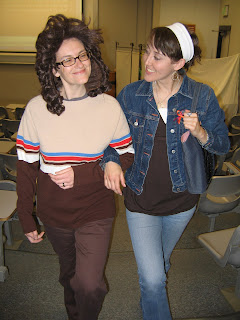 Jean has managed to stop smoking by wearing a Louis XV wig, but Claudine finally accepts to go shopping with him in public anyway.
 Scene 6: Souvenir. A group of friends spending the afternoon at an art museum start to wonder if we've all evolved so far that all we do anymore is think. (Frédérique Pesin, Lucas Sweet, Courtney Gregory, Catherine Peterson, and Shaun McCullough.)
 Getting in touch with their inner fish, the friends return to their prehistoric origins and swim offstage.
 And here's the whole cast again, with me and my amazing stage manager Rachel Ladasky sitting in front! Wish us luck this weekend....it sounds like a lot of people are planning on coming! (Click here to read about how it went and where we donated the proceeds.)
 As I mentioned earlier this month, this play is entirely in French (with English "subtitles" projected above the stage), as were our rehearsals, which makes for a great immersion experience (as good as it gets here in northern Colorado, at least). Here's what I say in my director's notes in the program:
Welcome to CSU's most ambitious French play in at least ten years! Théâtre sans animaux is twice as long as the others I've directed here. Published in 2001, it's also replete with rapid-fire slang, idioms, and other expressions that raise our eyebrows and contort our tongues. (This means, though, that my students can now say the French equivalent of things like "That's freakin' scary" and "skank" with ease--they've delighted in learning words that we don't normally cover in French class!) And since each scene that makes up Théâtre sans animaux is not connected to the others in the play, we've had to figure out who the characters are, what they want, and what's the point of the scene--six times! It's as if we're presenting six mini-plays to you today, each its own entity. I'm sure you'll agree that these gutsy actors and the stage manager--who holds it all together--have done a remarkable job with this task.
These six plays are a fascinating combination of linear, straightforward storytelling and vibrant characters interrupted by some absurdist conceits. A father and his teenaged daughter who sit down for their first real conversation in years--prompted by the fact that he can't remember her name. A long-married couple with different religious beliefs who must deal with the arrival of an enormous ballpoint pen in their living room on a Sunday morning. A bride struggling to support her new husband's efforts to stop smoking, wanting to help him but also embarrassed by the ridiculous item he insists on wearing. While maybe these exact situations haven't happened to us, we can still identify with many of the characters and themes in the plays--sibling rivalries, lovers who want different things, people who overanalyze life instead of simply experiencing it. And doesn't every family have a diva like Simone? Merci beaucoup for joining us for this adventure. We hope that Théâtre sans animaux makes you laugh and makes you think. Laissez-vous porter par le courant!
 Here's our performance space: a lecture hall on campus. We have a very simple set--since there's no backstage area--and we also have to contend with a big audiovisual station that holds a projector, DVD player, and much more. (It's the big tan thing on the right.) In this scene, it becomes a bar. Later on, it's a dressing room, and at the end, a statue.
 Scene 1: Égalité-Fraternité. Beth Santerre as Jacques, annoncing to his older brother André (a famous writer, played by Catherine Peterson), that he has become smarter than him.
 Scene 2: Tragédie. Louise (Ashley Kidder) tries to convince her recalcitrant husband Jean-Claude (Shaun McCullough) to say "bravo" to her sister Simone after her opening night at the Comedie Francaise.
 Patricia Pineiro-Nunez as Simone the diva in Tragédie.
 Scene 3: Monique. Papa (Lucas Sweet) gives advice to his daughter (Alison Baumgartner), even though he can't remember her name.
 The daughter confronts her father about his forgetfulness.
 Scene 4: Dimanche. Mom (Julia Thornton) expounds on the joys of living in the Creuse while her teenage daughter Severine (Lucy Tunna) mocks her.
 Severine and her father (Courtney Gregory) measure the enormous ballpoint pen that has crashed through their living room ceiling.
 Scene 5: Bronches. Jean (Frédérique Pesin) comforts his new wife Claudine (Jessi Day), who's worried that Jean, a former smoker, will get lung cancer.
 Scene 6: Souvenir. A group of friends spending the afternoon at an art museum start to wonder if we've all evolved so far that all we do anymore is think. (Frédérique Pesin, Lucas Sweet, Courtney Gregory, Catherine Peterson, and Shaun McCullough.)
 And here's the whole cast again, with me and my amazing stage manager Rachel Ladasky sitting in front! Wish us luck this weekend....it sounds like a lot of people are planning on coming! (Click here to read about how it went and where we donated the proceeds.)
Tuesday, April 17, 2007
the very hungry caterpillar = a very eager reader
I've mentioned that I'm tutoring Julia, a six-year-old who's struggling with reading in English, and that I love using drama as a teaching tool, so I thought I'd share an example of an activity that could be done with kids learning either their first or second language!
You probably know the classic picture book The Very Hungry Caterpillar by Eric Carle, about a ravenous little guy who eats his way through leaves, fruits, sausages, and ice cream cones before building a cocoon around himself and later emerging as a butterfly. I made color copies of the leaf, the butterfly, the sun, the cocoon, and many of the foods he ate, backed the pictures with cardboard, and glued them to plastic knives (since we didn't have any popsicle sticks).

Then I made a caterpillar with loopy brown chenille yarn and brown pipe cleaners and glued it to cardboard(appropriately enough; did you know that the French word "chenille" means, in fact, "caterpillar"?).

After Julia and I had read the book together several times (it was too hard for her to read straight through by herself), we decided who would hold which puppets, where we'd move them when, and which words/lines each of us would read (with our reading some of them together as well). We then performed our caterpillar play for the people hanging around the children's section of the public library, which even has a little puppet theatre for the kids to use! (But this sort of thing can also happen from behind a couch or a counter or in a large appliance-sized box with a square cut out for the performance space.)
As a follow-up, I made a little book called "The Very Hungry Julia" with lines inspired by the caterpillar book: "On Monday, Julia ate ________. On Tuesday, Julia ate ________." And so forth, concluding with "And then Julia turned into a _______." Her "homework" was to fill in one page each day with a description of what she ate and draw a picture.
While this one activity didn't turn Julia into an amazing reader, it did help her slow down and use context (the pictures, the repetition of days of the week, predicting what the caterpillar would transform into) to figure out words she didn't recognize. Reading it a total of five times over two days helped reinforce the new words and built up her confidence. And being able to perform it for her dad and other people made her feel important and capable and creative.
Now that I've got these colorful paper puppets, I'm planning on using them and the Caterpillar book with the four- and six-year-olds I tutor in French. I'll teach them the key vocab for new words like "caterpillar" and "cocoon," read the French translation with them, encourage them to interact with the text by asking questions all along, and then we'll perform the puppet show with me as the narrator, one of them as the caterpillar, and one of them as the foods the caterpillar eats. While they don't know enough French to tell the story themselves (even if we change it to the present tense), they'll be able to follow along with the puppets and chime in on words like "butterfly" and "ice cream."
I hope to find or create more interactive book-related activities to do with all my tutees! Any suggestions?
You probably know the classic picture book The Very Hungry Caterpillar by Eric Carle, about a ravenous little guy who eats his way through leaves, fruits, sausages, and ice cream cones before building a cocoon around himself and later emerging as a butterfly. I made color copies of the leaf, the butterfly, the sun, the cocoon, and many of the foods he ate, backed the pictures with cardboard, and glued them to plastic knives (since we didn't have any popsicle sticks).

Then I made a caterpillar with loopy brown chenille yarn and brown pipe cleaners and glued it to cardboard(appropriately enough; did you know that the French word "chenille" means, in fact, "caterpillar"?).

After Julia and I had read the book together several times (it was too hard for her to read straight through by herself), we decided who would hold which puppets, where we'd move them when, and which words/lines each of us would read (with our reading some of them together as well). We then performed our caterpillar play for the people hanging around the children's section of the public library, which even has a little puppet theatre for the kids to use! (But this sort of thing can also happen from behind a couch or a counter or in a large appliance-sized box with a square cut out for the performance space.)
As a follow-up, I made a little book called "The Very Hungry Julia" with lines inspired by the caterpillar book: "On Monday, Julia ate ________. On Tuesday, Julia ate ________." And so forth, concluding with "And then Julia turned into a _______." Her "homework" was to fill in one page each day with a description of what she ate and draw a picture.
While this one activity didn't turn Julia into an amazing reader, it did help her slow down and use context (the pictures, the repetition of days of the week, predicting what the caterpillar would transform into) to figure out words she didn't recognize. Reading it a total of five times over two days helped reinforce the new words and built up her confidence. And being able to perform it for her dad and other people made her feel important and capable and creative.
Now that I've got these colorful paper puppets, I'm planning on using them and the Caterpillar book with the four- and six-year-olds I tutor in French. I'll teach them the key vocab for new words like "caterpillar" and "cocoon," read the French translation with them, encourage them to interact with the text by asking questions all along, and then we'll perform the puppet show with me as the narrator, one of them as the caterpillar, and one of them as the foods the caterpillar eats. While they don't know enough French to tell the story themselves (even if we change it to the present tense), they'll be able to follow along with the puppets and chime in on words like "butterfly" and "ice cream."
I hope to find or create more interactive book-related activities to do with all my tutees! Any suggestions?
Wednesday, April 11, 2007
the drama of teaching languages
As my local readers know, I'm directing a play in French at school this semester, Théâtre sans animaux. My fourth one! It actually counts as a French class and the students get academic credit for it--as well they should, since it's an intense immersion experience. We've discussed the play in French, written about it in French, held rehearsals in French, memorized the lines in French, and dealt with costumes, props, and publicity all in French.
In my mind (and a lot of other people's--see my thoroughly researched Masters thesis if you want proof!), this is an excellent way to learn and practice a language if you can't spend time in a country where the language is spoken. Because, see, we're not reading dorky little stories from a textbook, we're not filling in the blank with the right form of the verb, we're not listening to an unnatural dialogue that has been contorted to highlight a certain grammatical structure: we're actually using the language to accomplish something. (Full disclosure: I do indeed use activities like that in my French grammar classes sometimes.) Our conversations at rehearsals involve hypothesizing ("If my character had a crush on that character, I'd..."), accepting and rejecting and reconciling ("No! I don't want to act like a turkey during the whole scene. Can I just gobble during the monologue and then run over here and sit down?" "Yes, but stick your hand behind your back and shake it to resemble a bird's tail feathers while you run"), stating and justifying opinions ("This is really funny because of what she said about the samurai earlier"), engaging in conversational gambits like introducing topics, turn-taking, and leave-taking ("Gotta go now! I promise I'll know my lines next time!"), and much, much more. Plus, they're learning entire conversations by heart--er, well, they'd better have learned them by April 27!--which means they're internalizing the sound and the feel and rhythm of the language, along with the vocabulary and grammar. And the benefits go beyond just improving fluency, pronunciation, and listening comprehension--their confidence and passion for the language increase.
You might also be surprised by how many students that I always thought of as shy enroll in a class like this. Taking on the role of somebody else for a play means that the quiet student doesn't have to be himself anymore; he's playing a role, wearing a mask (figuratively and sometimes literally) that enables him to present himself differently than he would in a traditional classroom. Drama in a second language is a valuable gift to give a student.
So this is what I do with my college students learning French in the US--but why not try it at home with your kids whom you're raising with more than one language? You can do improvisations (a la "Whose Line is it Anyway?"), give dramatic readings of poems, act out fairy tales (and then modify them by updating them to modern times or introducing characters from other fairy tales or movies--"Snow White and the Seven Elmos," anyone?), give puppet shows--tons of possibilities exist. Try it at the playgroup, the library, or as an after-school activity too.
To learn more about the theory behind drama as a language teaching technique, get lists of recommended resources, and see messages and files and links from recent online workshops on this topic, visit the following websites: the TESOL (Teachers of English to Speakers of Other Languages) Drama interest section page, the TESOL workshop on drama theory, the TESOL workshop on readers' theatre, and the TESOL workshop about drama techniques in the language classroom. (The latter three are Yahoo!Groups which require you to sign up to access the materials, but it's a very easy process. As we had literally hundreds of messages in each six-week online workshop, you might want to start with the "files" and "links" sections for ideas before skimming over the archived posts. And if you'd like to know more about the last French play I did, you can read an article I wrote in the drama theory workshop files. Unfortunately it's not posted anywhere else so I can't link to it directly!)
I'm curious--has anyone tried drama in a second language with younger children? Please tell us about it by clicking on "comments" if you have!
And click here to see photos and learn more about our production!
In my mind (and a lot of other people's--see my thoroughly researched Masters thesis if you want proof!), this is an excellent way to learn and practice a language if you can't spend time in a country where the language is spoken. Because, see, we're not reading dorky little stories from a textbook, we're not filling in the blank with the right form of the verb, we're not listening to an unnatural dialogue that has been contorted to highlight a certain grammatical structure: we're actually using the language to accomplish something. (Full disclosure: I do indeed use activities like that in my French grammar classes sometimes.) Our conversations at rehearsals involve hypothesizing ("If my character had a crush on that character, I'd..."), accepting and rejecting and reconciling ("No! I don't want to act like a turkey during the whole scene. Can I just gobble during the monologue and then run over here and sit down?" "Yes, but stick your hand behind your back and shake it to resemble a bird's tail feathers while you run"), stating and justifying opinions ("This is really funny because of what she said about the samurai earlier"), engaging in conversational gambits like introducing topics, turn-taking, and leave-taking ("Gotta go now! I promise I'll know my lines next time!"), and much, much more. Plus, they're learning entire conversations by heart--er, well, they'd better have learned them by April 27!--which means they're internalizing the sound and the feel and rhythm of the language, along with the vocabulary and grammar. And the benefits go beyond just improving fluency, pronunciation, and listening comprehension--their confidence and passion for the language increase.
You might also be surprised by how many students that I always thought of as shy enroll in a class like this. Taking on the role of somebody else for a play means that the quiet student doesn't have to be himself anymore; he's playing a role, wearing a mask (figuratively and sometimes literally) that enables him to present himself differently than he would in a traditional classroom. Drama in a second language is a valuable gift to give a student.
So this is what I do with my college students learning French in the US--but why not try it at home with your kids whom you're raising with more than one language? You can do improvisations (a la "Whose Line is it Anyway?"), give dramatic readings of poems, act out fairy tales (and then modify them by updating them to modern times or introducing characters from other fairy tales or movies--"Snow White and the Seven Elmos," anyone?), give puppet shows--tons of possibilities exist. Try it at the playgroup, the library, or as an after-school activity too.
To learn more about the theory behind drama as a language teaching technique, get lists of recommended resources, and see messages and files and links from recent online workshops on this topic, visit the following websites: the TESOL (Teachers of English to Speakers of Other Languages) Drama interest section page, the TESOL workshop on drama theory, the TESOL workshop on readers' theatre, and the TESOL workshop about drama techniques in the language classroom. (The latter three are Yahoo!Groups which require you to sign up to access the materials, but it's a very easy process. As we had literally hundreds of messages in each six-week online workshop, you might want to start with the "files" and "links" sections for ideas before skimming over the archived posts. And if you'd like to know more about the last French play I did, you can read an article I wrote in the drama theory workshop files. Unfortunately it's not posted anywhere else so I can't link to it directly!)
I'm curious--has anyone tried drama in a second language with younger children? Please tell us about it by clicking on "comments" if you have!
And click here to see photos and learn more about our production!
Subscribe to:
Posts (Atom)