My dear friend Amy and her three children (ages five and under) recently stayed with us for a couple of days during a visit to Colorado from Mississippi, and they delighted me (and confused my husband) with their mix of French and English and baby talk, narrative and songs and questions that filled the house during their stay.
Amy's been speaking French to them since birth, and she is well suited for this task: she majored in French as an undergrad, spent a year studying in Rennes, acquired a near-flawless pronunciation, and then received a Masters in Teaching English as a Second Language, so she knows quite a bit about language acquisition. She's also home with the kids during the day and is home-schooling Lily, age 5. (Lily will start learning to read in French a little later, about age 8.) Amy's husband doesn't speak French (but understands some), so their exposure comes exclusively from Amy, books, and music.
Lily is, naturally, the most bilingual of the three of them. She can carry on simple conversations in French, sing many songs in French, and pronounce words in French with a native-like accuracy (her English pronunciation reveals no French influence either). She also shows evidence of code-switching (alternating between French and English, sometimes even within the same sentence), for example, answering a question in English with oui and calling her mom Maman. Amy reports that Lily does less of this than she used to, though. I can remember exchanges like the following from when Lily was 2 years old:
Amy: Lily, tu te caches? ("Are you hiding?" This construction uses the reflexive pronoun te to imply "hiding yourself" rather than "hiding something else.")
Lily, sticking her head out of the closet: I te caches! ("I'm hiding!" She knew what the words meant but hadn't yet learned the grammar to manipulate the reflexive pronoun, and she wasn't cognizant yet of the fact that English and French were different tongues.)
Amy: Joue pas avec le micro-onde! ("Don't play with the microwave!")
Lily, punching buttons on my microwave, opening its door, and sticking her hand inside, surprised: Micro-onde hot!
Code-switching* is a natural stage that people go through when learning two languages. It can, in fact, become a conscious choice on the part of the speaker. I'm not sure that Lily is always aware that she code-switches. She does know now that English and French are different ways of saying the same thing and that she can't speak French with her dad. At one point, I asked her to sing me a song in French, and she asked Amy, "Is 'Fais Pipi' French or English?" So she can communicate just fine but can't always assign the labels to what she's saying. This will come soon.
Speaking of the song "Fais Pipi," three-year-old Gregory is already starting to invent with the language. This is a cute little song that they sing when they go potty: "Fais pipi sur le gazon/Pour arroser les coccinelles/Fais pipi sur le gazon/Pour arroser les papillons." (Go pee-pee on the grass to water the ladybugs, Go pee-pee on the grass to water the butterflies.) Well, Greg has his own version where he substitutes the rhyming word "garçon" (boy) for "gazon" (grass)! Very clever and funny, and he knows it. Greg talks nearly nonstop, sometimes in English, sometimes in French, and sometimes in an incomprehensible babble that seems to make perfect sense to him. (Amy had a speech therapist check him out, who said that they don't need to worry about him and that the gibberish should start working itself out by age four.)
My non-francophone husband, Ed, had the hardest time understanding Greg simply because he couldn't tell what was French and what was unintelligible English. And at one point at the dinner table, Greg counted confidently to 20 in well-pronounced French, while Ed, an engineer with a PhD, put his head on the table and said in monolingual dismay, "I've been out-counted by a three-year-old!"
One-and-a-half-year-old Lia doesn't say much yet, but she repeats a lot of what she hears, in English or French, including the songs that her older siblings sing.
I was very encouraged by Amy's family's visit. It showed me that with enough input, the kids can learn French, even in a small town in Mississippi and with a father who can't speak French with them.
*(Click here for a clearer and more accurate account of code-switching and other features of bilingual speech.)
Curious about Amy's kids' progress? Click here for an update a year later.

Saturday, July 29, 2006


Monday, July 24, 2006
teaching kids about the European Union
Just heard about this website that offers brochures, maps, and other materials for children learning about the European Union, translated into all the languages of the EU! Here's a description of one of the booklets (available online):
"Europe: a beautiful continent with a fascinating history. It has produced many of the world’s famous scientists, inventors, artists and composers, as well as popular entertainers and successful sports people. For centuries Europe was plagued by wars and divisions. But in the last 50 years or so, the countries of this old continent have at last been coming together in peace, friendship and unity, to work for a better Europe and a better world. This book for children (roughly 9 to 12 years old) tells the story simply and clearly. Full of interesting facts and colourful illustrations, it gives a lively overview of Europe and explains briefly what the European Union is and how it works. Each chapter links to an online quiz, and there are games on the ‘Europa Go’ website."
Any kids out there who want to write a review of the booklet and give us their perspective?
"Europe: a beautiful continent with a fascinating history. It has produced many of the world’s famous scientists, inventors, artists and composers, as well as popular entertainers and successful sports people. For centuries Europe was plagued by wars and divisions. But in the last 50 years or so, the countries of this old continent have at last been coming together in peace, friendship and unity, to work for a better Europe and a better world. This book for children (roughly 9 to 12 years old) tells the story simply and clearly. Full of interesting facts and colourful illustrations, it gives a lively overview of Europe and explains briefly what the European Union is and how it works. Each chapter links to an online quiz, and there are games on the ‘Europa Go’ website."
Any kids out there who want to write a review of the booklet and give us their perspective?
Friday, July 21, 2006
Tête-à-tête

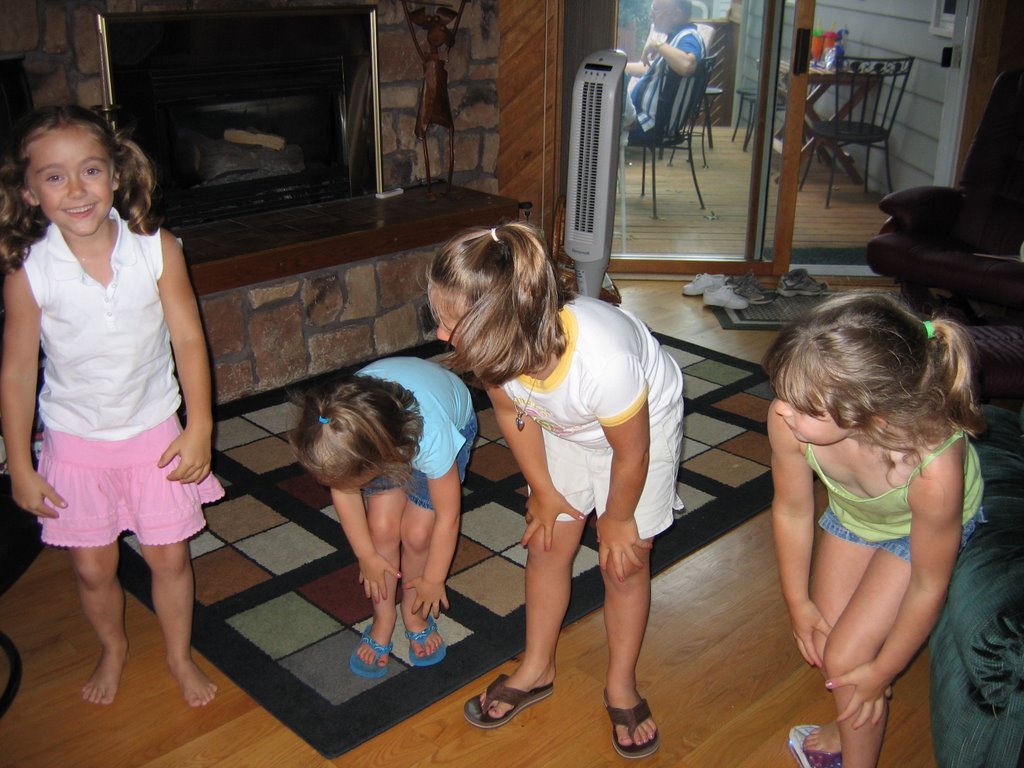
Meet my second cousins, Keira, Brianne, Lauren, and Megan, ages 4 to 7, who showed significantly more enthusiasm than my regular students when I recently suggested playing a game to teach them a song in French. They only knew a couple of words in French already--bonjour and voilà (which Lauren charmingly spelled "wala" on a homemade card for my mom)--but threw themselves into a translated version of "Head, Shoulders, Knees and Toes" with shouts of glee when they recognized the melody and felt very proud of themselves when they could figure out what tête, épaule, and all the rest meant. We practiced the eight body parts for the song by touching our own têtes and so on while saying the word in French. Occasionally I'd touch my feet, though, and say la bouche or something else that didn't fit, and they'd usually catch me on it. I also taught them two conjugated verbs--touchez (so we could then play Jacques a dit, or Simon Says) and fermez (so they could tell toddler Paul to "Fermez la bouche!", which they thought was the funniest thing ever). Including my words of praise to them (like fantastique! and très bien!), definite articles that I threw in inconsistently (sometimes le genou and other times just genou), and the structure for showing possession ("Touchez les pieds de Dad! Touchez la tête de Paul!"), that makes over a dozen words and expressions in French that they were able to recognize after only 15 minutes. And I never had to give them the English translation of any of them! Producing the words on their own was harder, of course, after such a brief lesson, but they managed to sing the song with me about an hour later to their parents, siblings, great aunt and uncle, and grandmother.
This is a lot more fun than what I normally do in the classroom (although on one notable occasion I had a group of 25 college students doing the Hokey Pokey in French to practice the vocab for body parts), but also much more exhausting!
Glossary:
Bouche (n.f.): mouth
Épaule (n.f.): shoulder
Fermer (v.): to close
Genou (n.m.): knee
Nez (n.m.): nose
Oeil (n.m.): eye (plural: yeux)
Oreille (n.f.): ear
Pied (n.m.): food
Tête (n.f.): head
Toucher (v.): to touch
Wednesday, July 19, 2006
What can parents do to help?
FL-TEACH, a foreign language teacher's listserv that I belong to, has recently been discussing how teachers can help parents help their kids learn languages. Here are a few ideas from the members:
Kate Chan, a Spanish teacher, recommends these techniques to help your child learn Spanish (which can be applied to any foreign language) and some additional study tips.
Joanna Kotecki writes: "I've told parents that they don't have to know the [second] language in order to be able to help their children. In order to review grammar, the parent can say the word in English and have the child give them the word in [the second language]. The parent should be able to tell immediately whether or not the child knows that vocab word. Also, I've told the parents to have their children try to explain the grammar concepts to them; after all, in order to be able to explain something, you must 'own' it first. "
David Graham pulled some salient ideas out of the article “Promoting a Language Proficient Society: What You Can Do” (ERIC Clearinghouse on Languages and Linguistics):
• Expose your children to people from varied language and cultural backgrounds.
• Participate in events where language and cultural diversity are celebrated.
• If you speak a language other than English, use it with your children.
• Speak positively to your children about the value of learning another language.
• Provide videos, music, and books in other languages.
• Send your children to summer language camps [I recommend Concordia Language Villages--see post below]. For older children, consider programs in which they can study languages abroad.
• Explore having an exchange student from another country in your home.
• Investigate opportunities for formal language study for your children, beginning as early as preschool and extending through their high school years.
• Reinforce existing language programs by expressing support for them to local, state, and national representatives.
• If your child is participating in a language program, talk to the teacher about what you can do at home to reinforce the learning that takes place in the classroom.
• If your child's school does not have a language program, talk with other parents, PTA members, and the principal about getting one started.
If anyone else has ideas about how parents can help kids learn languages, even if the parents don't speak the language themselves, please click on "post a comment" below to share with us!
Tuesday, July 18, 2006
more resources from the French teachers' convention
Here are some other resources worth mentioning that I learned about (or was reminded of) at the AATF convention this month:
Concordia Language Villages (throughout Minnesota) are amazing: they are summer immersion camps for 14 different languages for kids through 12th grade. In high school, I attended Sjolunden, the Swedish village, for two weeks, and Lac du Bois, the French village, for a month (and then got credit for French 2 because it's so intensive). They recreate the country where the language is spoken, right down to exchanging your money for the other country's currency, feeding you food typical of that place, and taking away reading material in English when you go through "customs." All the activities, from sports and meals, are centered on exposing the campers to the target language and teaching them about the target culture(s), and there are formal language classes several times a day as well. It's all extremely interactive and high energy with great communicative activities. (Plus I can still sing songs from both camps 15+ years later!) I would recommend these camps to any child learning any language they offer (from Spanish to Arabic and Korean), even if the child is a complete beginner. (And last year, one of my former students worked as a counselor at Lac du Bois! I was thrilled.)
L'Académie des Enfants, a French preschool in Chicago modeled after France's École Maternelle, also offering classes for older students at The French Institute of the North Shore (the director of this school gave the presentation on comptines that I mentioned earlier.) I would love to teach at a place like these! (Of course, they only hire native speakers.) Take a look at the sorts of classes they offer (and their rationales).
I also attended a presentation by Muriel Vergnaud, a singer, musician, and teacher of French to children. A native speaker, she has written many songs to introduce kids to French vocabulary and ideas, and each song that she showed us has actions that accompany it (moving to different colored panels on a parachute, for example, or using handmade sock puppets). Her songs are also easily modified to target other themes and age groups. You can visit her website to hear some of her songs, read about LYS, her multi-arts French program for young children, and see her philosophy about working with children and music.
Finally, here are a few publishers whose materials I admired; many of these sites have online catalogs you can browse:
World of Reading, with lots of books and CDs in many foreign languages (and also ESL) for children.
Pierre Books, where I found the textbook ABC Pour Commencer that I mentioned in a previous post; they specialize in French and Spanish.
Scholastic Books (Canada): Remember the book orders that we'd get in elementary school? Here are those types of books in French!
Tralco-Lingo Fun, more materials in French.
The French Workshop offers mostly non-book materials (tours of Paris on CD-ROM, vocab CD-ROMsreproducible workbooks about holidays and grammar review and so forth, bulletin board designs, simple workbooks about French culture, photo cards, and more).
And finally, the official website for Tatou le Matou, a textbook series for young children learning French (but, according to the exhibitor, for kids older than those who would use ABC Pour Commencer, which I bought to use with Carl when he's a toddler). I haven't examined these materials closely, but what I saw looked thorough and impressive.
If you have questions, ideas, or other sources (books, camps, schools) that you recommend, please share them by clicking on "post a comment!"
Concordia Language Villages (throughout Minnesota) are amazing: they are summer immersion camps for 14 different languages for kids through 12th grade. In high school, I attended Sjolunden, the Swedish village, for two weeks, and Lac du Bois, the French village, for a month (and then got credit for French 2 because it's so intensive). They recreate the country where the language is spoken, right down to exchanging your money for the other country's currency, feeding you food typical of that place, and taking away reading material in English when you go through "customs." All the activities, from sports and meals, are centered on exposing the campers to the target language and teaching them about the target culture(s), and there are formal language classes several times a day as well. It's all extremely interactive and high energy with great communicative activities. (Plus I can still sing songs from both camps 15+ years later!) I would recommend these camps to any child learning any language they offer (from Spanish to Arabic and Korean), even if the child is a complete beginner. (And last year, one of my former students worked as a counselor at Lac du Bois! I was thrilled.)
L'Académie des Enfants, a French preschool in Chicago modeled after France's École Maternelle, also offering classes for older students at The French Institute of the North Shore (the director of this school gave the presentation on comptines that I mentioned earlier.) I would love to teach at a place like these! (Of course, they only hire native speakers.) Take a look at the sorts of classes they offer (and their rationales).
I also attended a presentation by Muriel Vergnaud, a singer, musician, and teacher of French to children. A native speaker, she has written many songs to introduce kids to French vocabulary and ideas, and each song that she showed us has actions that accompany it (moving to different colored panels on a parachute, for example, or using handmade sock puppets). Her songs are also easily modified to target other themes and age groups. You can visit her website to hear some of her songs, read about LYS, her multi-arts French program for young children, and see her philosophy about working with children and music.
Finally, here are a few publishers whose materials I admired; many of these sites have online catalogs you can browse:
World of Reading, with lots of books and CDs in many foreign languages (and also ESL) for children.
Pierre Books, where I found the textbook ABC Pour Commencer that I mentioned in a previous post; they specialize in French and Spanish.
Scholastic Books (Canada): Remember the book orders that we'd get in elementary school? Here are those types of books in French!
Tralco-Lingo Fun, more materials in French.
The French Workshop offers mostly non-book materials (tours of Paris on CD-ROM, vocab CD-ROMsreproducible workbooks about holidays and grammar review and so forth, bulletin board designs, simple workbooks about French culture, photo cards, and more).
And finally, the official website for Tatou le Matou, a textbook series for young children learning French (but, according to the exhibitor, for kids older than those who would use ABC Pour Commencer, which I bought to use with Carl when he's a toddler). I haven't examined these materials closely, but what I saw looked thorough and impressive.
If you have questions, ideas, or other sources (books, camps, schools) that you recommend, please share them by clicking on "post a comment!"
Thursday, July 06, 2006
comptines and CDs and bingeing on books
I'm currently in Milwaukee, WI for the annual conference of the AATF (American Association of Teachers of French) where I'll be presenting on a topic completely unrelated to teaching French to infants. After only two days, I've already purchased six CDs of children's songs (four traditional, one Christmas, one comptines) and a whole program for teaching French to pre-literate children. It's called ABC pour commencer and includes a teacher's guide, two tapes, student's "textbook," and student's workbook. Perhaps I'm a sucker--it wasn't cheap--but I liked it the best of the materials targeting very young learners. Carl won't need it for a few years yet, which will give me time to figure out whether I like it or not. And I might even get it use it on a few guinea pigs next week: my friend Amy, who is fluent in French, is bringing her three children (under five) for a three-day visit. She's spoken some French with them, so maybe they'll test drive these materials for me! (I think I'll also try to interview each of them--at least the two that can speak in sentences--to find out what they think about French. Stay tuned!)
To my disappointment, very few of the sessions at this conference are related to young children and language acquisition. So far I've only attended one--but it was a good one! Maria Kurt's presentation on comptines--nursery rhymes and finger plays--gave a thorough list of the benefits of using them with kids (complete with video clips of American kids at a French preschool chanting them in unison). And of course, we all got to learn and practice a few! In "Monsieur Pouce" (Mr. Thumb), the child convinces a sleeping Mr. Thumb to wake up and greet his family:
(Make a fist with your left hand, hiding the thumb inside, and use your right hand to knock on your fist) Toc, toc toc! Monsieur Pouce, es-tu la?
(Put finger to lips) Chut!
(Put hands together under a tilted head and pretend to sleep) Je dors!
(Knock on your fist again) Toc, toc, toc! Monsieur Pouce, es-tu la?
(Thumb peeks out of the fist and nods its head as it speaks) D'accord, j'arrive.
(Thumb touches each other finger) Bonjour Papa, bonjour Maman, bonjour grande soeur, bonjour petit frere!
(Hand waves) Bonjour, bonjour, bonjour!
To my disappointment, very few of the sessions at this conference are related to young children and language acquisition. So far I've only attended one--but it was a good one! Maria Kurt's presentation on comptines--nursery rhymes and finger plays--gave a thorough list of the benefits of using them with kids (complete with video clips of American kids at a French preschool chanting them in unison). And of course, we all got to learn and practice a few! In "Monsieur Pouce" (Mr. Thumb), the child convinces a sleeping Mr. Thumb to wake up and greet his family:
(Make a fist with your left hand, hiding the thumb inside, and use your right hand to knock on your fist) Toc, toc toc! Monsieur Pouce, es-tu la?
(Put finger to lips) Chut!
(Put hands together under a tilted head and pretend to sleep) Je dors!
(Knock on your fist again) Toc, toc, toc! Monsieur Pouce, es-tu la?
(Thumb peeks out of the fist and nods its head as it speaks) D'accord, j'arrive.
(Thumb touches each other finger) Bonjour Papa, bonjour Maman, bonjour grande soeur, bonjour petit frere!
(Hand waves) Bonjour, bonjour, bonjour!
Subscribe to:
Posts (Atom)